Who gets to be the expert? Whose knowledge counts in anti-racist social work practice?
On 12 March, we had 61 attendees plus an additional room of students for “Who Gets to Be the Expert? Whose Knowledge Counts in Anti-Racist Social Work Practice?” presented by Samiat Oshodi, Doctoral Researcher – University of Kent.
The presentation looked at how professional systems trust or marginalize different forms of knowledge and the influence of epistemic oppression (where individuals are persistently excluded from contributing knowledge, or when their expertise is undervalued or dismissed) and epistemic exploitation (when individuals are expected to perform the “unpaid labor” of educating others about oppression without adequate support or recognition). As well as how Critical Race Theory and ‘whiteness’ create structural norms and expectations by default.
Our attendees went into breakout rooms to do one of two breakout room tasks:
- To reflect on the below assessment
Reason for referral:
Children’s Services received a referral from the school expressing concerns regarding the children’s inconsistent attendance and frequent tiredness during the school day. The school reported that the children often arrive late and occasionally report staying overnight at different family members’ homes. Professionals expressed uncertainty regarding the children’s living arrangements and whether there is sufficient routine and consistency in the home environment.
The purpose of this assessment is to consider whether the children’s daily care arrangements are meeting their needs and whether any additional support or intervention is required to promote their welfare and educational engagement.
Assessment outcome:
During the assessment, the mother explained that the children regularly spend time with extended family members, including their maternal grandmother and aunt, who live nearby. She described this arrangement as a form of shared caregiving within the family, explaining that relatives support childcare when she is working. The mother stated that this is a common and accepted approach to parenting within her cultural community.
However, professionals have raised concerns that the children appear to move between multiple households during the week, which may limit the development of consistent routines, particularly in relation to school attendance and bedtime arrangements. While the children appear comfortable with their extended family members and describe these relationships positively, the current arrangements make it difficult for professionals to identify a clear and consistent caregiving structure outside of the mother’s direct care.
Although the mother considers the involvement of extended family members to be supportive and beneficial, the lack of a clearly defined primary caregiving routine may contribute to the concerns raised by the school regarding punctuality and tiredness. Further consideration will therefore be given to whether additional support may be required to ensure that the children experience consistent routines that support their education and overall wellbeing.
Breakout room reflections:
- The group felt it was unfair for the school to escalate the matter to Social Services without first having a direct discussion with the family to understand the situation and offer support if necessary.
- The group noted that current systems are often rooted in an “old-fashioned Western nuclear family model” that fails to understand the “village system” of caregiving common in many cultures but also in the Western world and is the reality of many children with split families.
- Reflections emphasized that the goal should be understanding how the family works rather than expecting the family to change to suit professional preferences.
- Rather than relying on perceptions of how a family “should” operate, social workers should speak directly to all caregivers to understand the support network.
- Instead of escalation, the focus should be on ensuring all caregivers are on the same page regarding the children’s needs.
- Participants observed that a professional’s own “normal” lived experience often dictates what they perceive as “abnormal,” leading to unfair judgments of households that are different but still full of love.
- The group felt the language in the assessment had a “judgmental undertone” that lacked a genuine desire to explore the family’s situations, strengths or depth of care.
- There was a concern that the assessment felt superficial, written more to satisfy a manager or “cover” the practitioner rather than to provide an in-depth safeguarding analysis.
- Switching Judgments to Strengths: Practitioners need to be able to identify the strengths in having multiple involved caregivers. Noting that in adult social care, having a large, involved support network is seen as a major positive as they are likely being cared for by people they prefer and it puts less pressure on social services.
2. Reflections on potential experiences suggested by bingo cards:
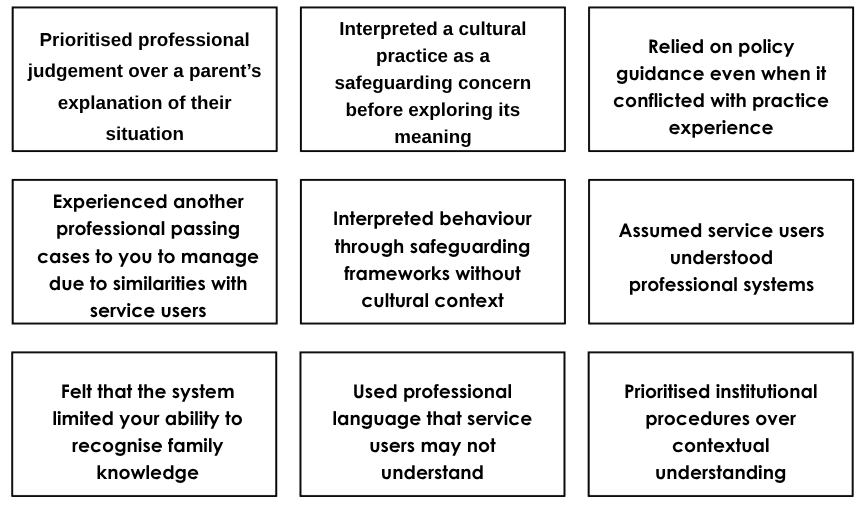
- Navigating cultural contexts in physical chastisement: The group discussed how cultural dynamics frame safeguarding processes, noting that while protective elements exist, there can be a lack of desire to explore these with families or provide enough understanding to the individual administering the punishment.
- The “western lens” vs. cultural customs: Participants reflected on how a lack of cultural understanding can lead to varying safeguarding responses in a Western context and how behaviour can be misinterpreted without specific cultural knowledge.
- The conflict of traditional practices and harm: The group addressed the deep conflict that arises with practices such as FGM; while acknowledged as a traditional cultural practice in some African countries, the group affirmed that it constitutes harm with long-term impacts on a child’s wellbeing, similar to concerns regarding “where to draw the line” with physical chastisement.
- Balancing parenting in differences of upbringing: Reflections included the challenges of growing up in different regions or parenting in new regions such as growing up in the Caribbean and parenting children in the UK. Where you have to find a balance in cultural practices and what is seen as ‘normal’ in the region you currently live in.
- The need for in-depth and honest dialogue: The group noted that professionals often avoid having honest, in-depth dialogues about what truly constitutes “risk” and primarily operate in being risk-adverse without developing more holistic understandings.
- Supervision and reflection: There was a strong emphasis on the necessity of supervision and dedicated time to reflect to ensure clear decision-making when assessing cultural differences and seeking opportunities to reflect with colleagues to question decision-making and assumptions.